Top Monel Alloy Suppliers for Corrosion Resistant Applications
When it comes to the Indian industrial landscape—from the massive chemical clusters in Gujarat to the offshore rigs in the Mumbai High and the bustling ports of Vishakhapatnam—the word "corrosion" isn't just a technical term; it’s a multi-billion-dollar headache. In the humid, salt-laden atmosphere of the Indian coast, standard stainless steel often has a lifespan measured in months, not years. This is where Monel alloys come into play, and it’s where we at DLX Alloy have spent years perfecting our metallurgical craft to support India’s growing "Blue Economy" and chemical dominance.
If you are searching for the "Top Monel Alloy Suppliers," you are likely looking for more than just a price per kilogram. You are looking for a material that won't give up when it's submerged in hot seawater or exposed to high-velocity hydrofluoric acid. In this guide, we’re going to look at the India-specific market for Monel, the science behind its legendary corrosion resistance, and why DLX Alloy is becoming the preferred partner for Indian B2B buyers who are tired of the "standard" commercial grade.
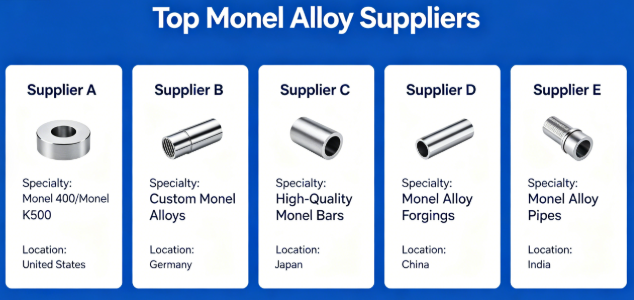
Monel alloys, primarily Monel 400 and Monel K-500, are unique because they are "natural alloys"—their Nickel and Copper ratios are roughly the same as those found in the ore from certain mines. But at DLX Alloy, we don't leave it to nature; we refine it to a precise science.
This is a solid-solution alloy that is as tough as it is versatile. It is one of the few materials that can handle being in contact with fluorine, hydrofluoric acid, and hydrogen fluoride.
The Secret Sauce: It’s the combination of Nickel (minimum 63%) and Copper (28-34%). This ratio provides a "passive" surface that is incredibly resistant to chloride-ion stress corrosion cracking—a common killer of 300-series stainless steels in Indian coastal environments.
Temperature Range: It stays strong from sub-zero temperatures up to about 450°C (842°F).
Take the corrosion resistance of 400 and add Titanium and Aluminum. By using a process called "age-hardening" or "precipitation hardening," we create an alloy that is three times stronger than standard Monel 400.
The Advantage: It is virtually non-magnetic down to -101°C. This makes it a go-to for specialized Indian defense applications and electronic sensors used in subsea oil exploration.
Mechanical Integrity: It maintains its hardness and strength in environments where high-velocity seawater would erode softer metals.
India’s industrial sector is currently in a "super-cycle." We’ve analyzed the demand coming from our Indian partners, and three key trends are dominating the Monel market:
The Desalination Boom: With water scarcity becoming a major issue, India is investing heavily in RO (Reverse Osmosis) and MSF (Multi-Stage Flash) desalination plants along the coast. The impellers, pumps, and heat exchangers in these plants require Monel 400 to survive the concentrated brine.
Chemical Hub Expansion: Gujarat and Maharashtra are home to some of the world’s largest refineries and chemical parks. The shift toward specialized chemical production (like agricultural chemicals and fluorinated compounds) has made Monel tubing an essential procurement item.
Marine Infrastructure & Defense: Under the "Make in India" initiative, domestic ship-building and naval defense are expanding. Monel K-500 is being increasingly specified for propeller shafts, valve stems, and fasteners that must endure decades of seawater exposure without maintenance.
At DLX Alloy, we focus on the "Precision Tier" of the market. While there are many suppliers who can ship large plates of Monel, we specialize in the high-stakes components: Seamless Tubing, Precision Rods, and High-Performance Capillaries.
Manufacturing Purity: We utilize Vacuum Induction Melting (VIM) and Electroslag Remelting (ESR). This removes trace impurities like Lead and Sulfur, which can weaken the alloy’s grain boundaries.
Tolerance Control: For our Indian clients in the instrumentation and valve industries, we provide tolerances as tight as ±0.02mm.
Surface Finish: We use a proprietary bright annealing process. Our tubes aren't just clean; they are "mirror-finished" on the inside. Why does this matter? Because in a high-velocity pump, a tiny surface scratch is where pitting corrosion starts. A smoother surface equals a longer life.
For Indian engineers drafting project specifications, these are the benchmarks we meet:
| Property | Monel 400 (UNS N04400) | Monel K-500 (UNS N05500) |
|---|---|---|
| Density (g/cm³) | 8.80 | 8.44 |
| Melting Point (°C) | 1300–1350 | 1315–1350 |
| Tensile Strength (MPa) | ≥ 480 | ≥ 960 (Age Hardened) |
| Yield Strength (0.2% MPa) | ≥ 195 | ≥ 690 (Age Hardened) |
| Elongation (%) | ≥ 35 | ≥ 20 |
| Magnetism | Slightly Magnetic | Non-Magnetic |
| Key India Application | Heat Exchangers / Brine Heaters | Valve Stems / Marine Shafts |
We’ve talked to hundreds of Indian procurement managers, and the same three "nightmares" keep coming up. Here is how DLX Alloy addresses them:
The Reality: Because Monel is expensive, some secondary suppliers in the local market mix in scrap or lower-grade alloys.
DLX Solution: We provide 100% Positive Material Identification (PMI) testing. Every shipment comes with a full EN 10204 3.1 Material Test Certificate (MTC). We track every tube back to the original heat of metal. In India, trust is everything, and we back our trust with data.
The Reality: Ordering from Europe or the US often involves 20-week lead times and complex logistics.
DLX Solution: We have optimized our logistics for the China-India corridor. Shipping to major Indian ports like Nhava Sheva or Mundra is significantly faster. We also maintain a "Rapid Drawing" program for custom-sized tubes, delivering in 6-8 weeks instead of 6 months.
The Reality: Standard tubes often fail at the bends or joints because of residual internal stress from the manufacturing process.
DLX Solution: Every Monel tube at DLX Alloy undergoes a full stress-relief anneal in a controlled atmosphere. This ensures the material is "relaxed" and ready to handle the pressure without cracking at the joints.
1. Is Monel 400 suitable for hydrofluoric (HF) acid? Yes. Monel 400 is arguably the most resistant material for HF acid across all concentrations, up to the boiling point. It is a staple in the alkylation units of Indian refineries.
2. Why is Monel K-500 non-magnetic? The addition of aluminum and titanium, combined with specific heat treatments, alters the crystal structure in a way that eliminates magnetism. This is why it’s used in "quiet" naval applications and sensitive drilling tools.
3. Can I weld Monel 400 to carbon steel? Yes, but you need to use the right filler metal (typically Monel Filler Metal 60 or 190). At DLX, we provide technical welding guides to our Indian clients to ensure their fabrication goes smoothly.
4. How does Monel compare to 316L in seawater? 316L will eventually pit and suffer from crevice corrosion in stagnant seawater. Monel 400 is virtually immune to this. If your project is meant to last 20+ years in the Indian Ocean, Monel is the only choice.
5. What is the typical lead time for an export order to India? For standard sizes, we can ship in 2-4 weeks. For custom-drawn precision tubing, it’s usually 6-8 weeks. We handle all the export documentation to make the customs process in India as smooth as possible.
6. Do you offer "Third-Party Inspection" (TPI)? Absolutely. We regularly work with TPI agencies like SGS, TUV, and BV. We can arrange for them to visit our facility to witness the testing of your order before it leaves for India.
7. Is your material NACE MR0175 compliant? Yes. Our Monel K-500 and 400 can be produced to meet NACE standards for "sour" oil and gas environments containing H2S.
8. Can you provide custom lengths? Yes. We offer fixed-length cutting to ±1mm. We know that material waste is a huge cost for Indian factories, so we help you minimize scrap by providing the exact lengths you need.
The search for the "Top Monel Supplier" isn't about finding the biggest company; it’s about finding the one that understands your specific environment. At DLX Alloy, we don't just see India as a market; we see it as a partner in engineering. Whether you are building a new desalination plant in Tamil Nadu or a specialized chemical reactor in Gujarat, we provide the metallurgical backbone that ensures your project survives the salt, the acid, and the pressure.
We believe in "Quality without Compromise," and for the Indian B2B buyer, that means a material that works the first time, every time.