Hastelloy C276 vs C22: Which Nickel Alloy is Better for Your Application
In highly corrosive industrial environments, choosing the right material is not just a technical decision—it directly impacts equipment lifespan, maintenance costs, and operational safety.
Two of the most widely used corrosion-resistant alloys are Hastelloy C276 (UNS N10276) and Hastelloy C22 (UNS N06022). While they share many similarities, their differences can significantly affect performance depending on the application.
At DLX Alloy, we help global industrial buyers select the most suitable alloy based on real-world operating conditions—not just datasheets.
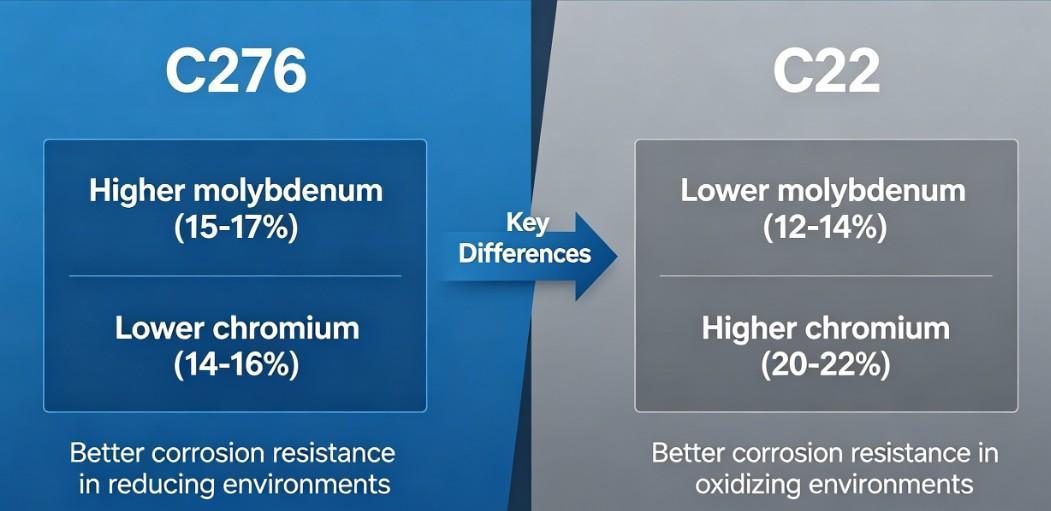
Overview of Hastelloy C276 and C22
Hastelloy C276 (UNS N10276)
Hastelloy C276 is a nickel-molybdenum-chromium alloy known for its excellent resistance to both oxidizing and reducing environments.
Key characteristics:
Outstanding resistance to wet chlorine
Excellent performance in hydrochloric acid
Strong resistance to localized corrosion
Hastelloy C22 (UNS N06022)
Hastelloy C22 is an advanced version of C276 with improved chromium content, offering enhanced resistance to oxidizing environments.
Key characteristics:
Superior resistance to pitting and crevice corrosion
Better performance in oxidizing acids
Wider application range
Chemical Composition Comparison
| Element | C276 (%) | C22 (%) |
|---|---|---|
| Nickel | Balance | Balance |
| Chromium | 14.5–16.5 | 20–22.5 |
| Molybdenum | 15–17 | 12.5–14.5 |
| Iron | 4–7 | 2–6 |
| Tungsten | 3–4.5 | ≤3 |
Mechanical Properties Comparison
| Property | C276 | C22 |
|---|---|---|
| Tensile Strength | ≥690 MPa | ≥690 MPa |
| Yield Strength | ≥283 MPa | ≥310 MPa |
| Elongation | ≥40% | ≥45% |
C22 slightly outperforms C276 in ductility and yield strength.
Corrosion Resistance: The Real Difference
1. Oxidizing Environments
C22 → Superior performance
C276 → Good but slightly weaker
Typical media:
Nitric acid
Ferric chloride
2. Reducing Environments
C276 → Better performance
C22 → Slightly less effective
Typical media:
Hydrochloric acid
Sulfuric acid
3. Pitting & Crevice Corrosion
C22 → Excellent resistance
C276 → Very good
C22 is often selected for mixed corrosive environments
Temperature Performance
| Property | C276 | C22 |
|---|---|---|
| Max Operating Temp | ~1040°C | ~1250°C |
C22 has a wider usable temperature range.
Applications Comparison
Chemical Processing
C276 → Acid handling, reactors
C22 → Multi-acid environments, high oxidizing conditions
FGD Systems (Power Plants)
C22 → Preferred for scrubbers
C276 → Used in less aggressive zones
Oil & Gas
C276 → Downhole tools, pipelines
C22 → Surface equipment, corrosion-prone systems
Environmental Systems
C22 → Waste treatment, pollution control
Industry Trend Insight
1. Shift Toward C22 in Complex Environments
Modern plants deal with mixed corrosive media → C22 demand increasing.
2. Cost vs Performance Optimization
C276 → Cost-effective
C22 → Performance-driven
3. Increasing FGD Demand
Global emission control regulations are driving demand for high-performance alloys.
Common Buyer Mistakes (Critical Section)
Mistake 1: Choosing Based on Price Only
Cheaper alloys lead to higher long-term costs.
Solution:
Evaluate total lifecycle cost, not just material price.
Mistake 2: Ignoring Corrosion Type
Not all corrosion is the same.
Solution:
Match alloy to specific chemical environment.
Mistake 3: Over-specifying Material
Using C22 where C276 is sufficient increases cost unnecessarily.
Solution:
Optimize material selection based on actual conditions.
Buyer Pain Points & DLX Solutions
Pain Point 1: Material Failure in FGD Systems
Solution: DLX provides C22 with proven performance in scrubbers.
Pain Point 2: Confusion Between Grades
Solution: Technical consultation for correct alloy selection.
Pain Point 3: Inconsistent Quality
Solution: Full traceability and strict inspection.
Pain Point 4: Long Lead Time
Solution: Stable production + global logistics.
Product Forms Available
At DLX Alloy, we supply:
Pipes & Tubes
Plates & Sheets
Bars & Rods
Wires
Standards:
ASTM B622 / B619 / B575
Surface:
Bright / Pickled
DLX Alloy vs General Suppliers
| Feature | DLX Alloy | Others |
|---|---|---|
| Alloy Expertise | Strong | Limited |
| Application Guidance | Yes | No |
| Customization | Full | Partial |
| Delivery | Stable | Variable |
FAQ
1. Which is better, C276 or C22?
It depends—C22 is better for oxidizing environments, C276 for reducing acids.
2. Is C22 worth the higher cost?
Yes, in highly aggressive or mixed environments.
3. Can C276 replace C22?
Only in less aggressive conditions.
4. Which alloy is best for FGD systems?
C22 is generally preferred.
5. Are both alloys weldable?
Yes, both have excellent weldability.
6. Do you provide custom sizes?
Yes, DLX Alloy supports full customization.
7. What industries use these alloys most?
Chemical, power, oil & gas, environmental.
8. How do I choose the right alloy?
Provide your working conditions—we’ll recommend the best option.
Conclusion
Choosing between Hastelloy C276 and C22 is not about which alloy is “better”—it’s about which is right for your specific environment.
Choose C276 → for strong reducing environments
Choose C22 → for oxidizing or mixed corrosion systems
At DLX Alloy, we don’t just supply materials—we help you make the right engineering decision.
We can provide customized solutions based on your project requirements.